This is a guest blog post from Jane Finette, Executive Program Manager, who works closely with me in Office of the Chair.
In a recent blog post Mitchell described why she has been eager to see the hiring process at Mozilla have a larger focus on cross-functional participation, particularly for senior leaders whom we expect to represent a broad swath of Mozilla. Enabling wider participation in how we hire for leadership has been our starting point. She notes we began organizing panel discussions for a broader set of people to talk to the candidate some time ago.
The need to hire for a new senior role, Vice President of Marketing Communications, presented an opportunity to further explore this new type of approach. Jascha Kaykas-Wolff, our CMO and the hiring manager for this role, and I sat down to plan and document some further experiments with the hiring process for this role. Our goal from the start was to explore two outcomes: an increased participation within the organization and the simultaneous creation of a meaningful process for candidates to evaluate us.
Enabling participation in the hiring process for the VP of MarComm position was particularly crucial because this person has a role that represents and communicates publicly about a broad swath of Mozilla. The VP of MarComms oversees the global communications, social media, user support and content marketing teams and works across the organization to develop impactful outbound communications for Mozilla and Firefox products.
What was the process?
Jascha and I designed the interview process right at the start with participation as one of the key objectives. Together we identified interviewers as peers, direct reports, expertise leaders and others who were not from the group where the candidate would work; in this case Marketing. We identified cross functional areas the hire would interact with on a regular and a geographic basis, these were people who might not otherwise have been part of the interview process.
Here is an overview of the process we devised:
1st round: Peers (no direct reports).
Purpose: Interviewing for values match, strong competency in area of expertise.
2nd round: Directs report + leaders in area of expertise, including cross-functional areas.
Purpose: Interviewing for leadership attributes, values match, competency in area of expertise.
3rd round: Panel – including moderator and panel members who were not part of the group where the candidate would work. Panel was a maximum of 7 people.
Purpose: Validate values match. Give insights into broader organizational dynamics.
4th round: Case study including peers + directs reports and a small selection of members of the panel. Maximum of 12 people.
Purpose: Place for the person to demonstrate their expertise and shine, and experience a typical environment.
5th round: CEO and Chairwoman
Purpose: Validate values match, leadership and skills where appropriate.
We conducted well over 50 screenings and entered 8 very well qualified candidates into our process. The process took approximately four months to complete, approximately the same amount of time required for an executive level hire.
What have we learned so far?
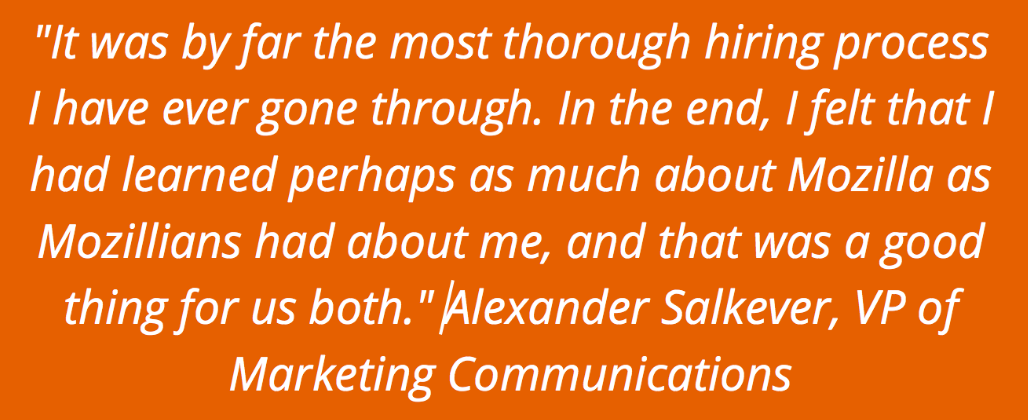
The hiring process for the VP of MarComm is now complete. Alex Salkever, joined Mozilla as our Vice President of Marketing Communications on May 18, 2016.
We have a hypothesis that increasing the level of diversity and participation will lead to stronger hires at Mozilla. We are continuing the pilot to explore this further.
(1) In our opinion interviews are both for the organization and the candidate
- By increasing the level of diverse participation, we have been able to get more input from across the organization, finding blind-spots and bias. In our pilot case, the role was intended to be hired outside of the US due to the global nature of the position. The hiring manager explained he was heavily influenced by his peers in the organization regarding the location of this hire, which could have led to a suboptimal situation if he had pushed with his original preference. Additionally, we chose a candidate who has strong technical chops for a Marcom lead and yet, the recommendation was shaped heavily by the feedback provided from the non-marketing/policy participants.
- We are exploring turning this into a repeatable interview process.
- We have created an environment where candidates can also evaluate us from multiple perspectives.
(i) By adding differing perspectives to our current hiring process, we are exposing a new hire to our unique culture and operating principles right from the start.
(ii) The new hire already knows and has the potential to have credibility with a significant number of people at Mozilla from the first day. The process is essentially a way of reputation building on a distributed basis.
(2) Participatory hiring process in senior levels is our starting point
- Our starting point for a more participatory hiring process is our senior roles. As Mitchell noted, “the more senior the role, the broader a part of Mozilla we expect someone to be able to lead, and the broader a sense of representing the entire organization we expect that person to have.” These roles require an ability to interact, motivate and work across teams, they also have the high potential to affect culture.
(3) Defining what success looks like helps identify who should participate in the hiring process
- A key practice to apply in all hiring processes: define (i) what success for the role will be and (ii) all the stakeholders in the organization whom can support success, this creates the pool of participants. In this case, we worked with both the hiring manager and the recruiter at the start of the process to design and determine the process.
(4) Add more people early on
- A previous learning indicated a broader group of diverse interviewees should be in the 3rd stage of the interview, not the last stage as their feedback proved to be critical in the decision process. This was upheld in this example. In order to invite a broad group to meet with a candidate, this could take the form of a panel to create an effective use of time.
Gotchas:
- We note that time taken by increasing participation in hiring could inhibit the process. In subsequent examples we intend to create and test a lightweight version of the process.
- When involving more people in the process, we must be careful to collect candidate feedback individually, as in larger group settings ‘group think’ can happen.
Often a standard type of interview process is designed for the company, rather than the individual being interviewed. The standard process is intended to maximize assessment in a core area of expertise, whereby candidates are evaluated by their manager, peers and direct reports in their domain only. This creates an unhealthy power balance and exposes a set of addressable biases in the process such as ones based on cultural fit, and skills gap perspectives from other areas of the company.
What’s next?
We will continue to explore, record results and share further findings. We have now begun another participatory hiring experiment at the ‘director’ level role. It’s an interesting question what piece of evidence would conclusively prove cross-functional and cross-level participation in hiring leadership brings benefits to an organization. We’ll continue to experiment.